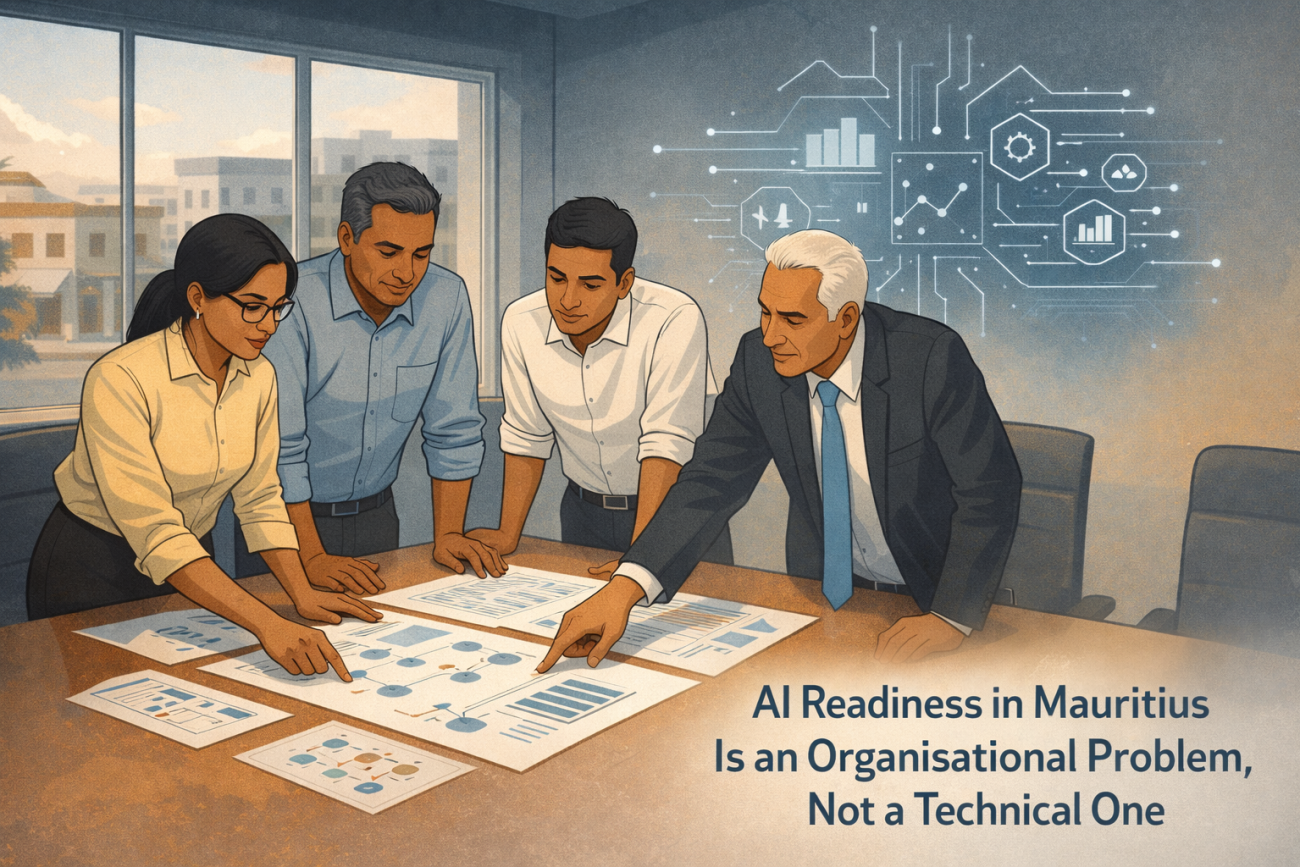
When “AI-ready” on paper isn’t ready in practice
On international indices, Mauritius looks impressively prepared. The country scores well on AI readiness rankings and has a formal AI strategy, an AI council, and a dedicated AI unit. Taken at face value, this suggests that “AI readiness Mauritius” is a solved question at the national level.
But these signals mostly measure things like policy documents, broadband coverage, and the existence of coordinating bodies. They do not tell you whether a particular ministry, parastatal, or SME has:
- Clear owners for data and AI-related risks
- Stable, well-understood processes
- The organisational bandwidth to change how work is done
Inside many organisations, the reality is closer to this: basic systems (accounting, inventory, CRM) are only partially integrated, data is scattered, and critical processes still run on paper, WhatsApp, and spreadsheets. From that position, AI is not the next logical step; it is several steps too far.
The key judgment here is that national AI scores and strategies should not be treated as proxies for actual organisational readiness. They are useful context, but they are not evidence that your own organisation is ready.
What SME adoption patterns are really telling us
Studies of ICT and Accounting Information Systems (AIS) adoption in Mauritian SMEs consistently point in the same direction. When owners decide whether to adopt a system, the decisive factors are:
- Do we feel in control of it?
- Is it easy enough to use with our current staff?
- Are our competitors or customers pushing us toward it?
Variables you might expect to dominate, like firm size, abstract “relative advantage”, or even perceived risk, often show up as weak or statistically insignificant in the Mauritian data.
When you extend this lens to AI adoption for SMEs, the picture sharpens:
- If a team struggles to keep a basic accounting system clean and up to date, any AI that depends on that data is built on sand.
- If the owner already feels overwhelmed by existing tools, an AI system that is harder to explain and control is unlikely to survive beyond a pilot.
- If staff turnover is high and training budgets are thin, the idea of maintaining an AI-enabled workflow becomes unrealistic.
The important point is not that AI is “too hard” technically. It is that the existing pattern of adoption shows a deeper organisational constraint: many SMEs have not yet demonstrated they can absorb and govern simpler digital systems over time. That is the real readiness test.
Leadership and decision architecture as the real leverage points
If AI readiness Mauritius-wide is mainly organisational, then the leverage is in leadership and decision architecture, not in tool selection.
For an SME, this starts with very concrete questions:
- Who in this business is authorised to say “yes” or “no” to changes in core processes?
- How do we decide which problems are worth solving with technology, and which are not?
- When a new system causes issues, who has the authority to pause, adjust, or roll it back?
In many Mauritian SMEs, these answers are concentrated in one or two people, often the owner and a trusted lieutenant, with limited time and many competing priorities. That structure can work for small, incremental changes. It is much more fragile when you introduce systems that require ongoing monitoring, data governance, and ethical judgments.
In government and larger organisations, the picture is similar but more layered. Creating an AI Council or AI Unit is a step, but it does not automatically produce:
- Cross-functional teams inside ministries that combine domain, legal, data, and IT expertise
- Clear escalation paths when an AI system behaves unexpectedly
- Shared understanding of who is accountable when an AI-enabled decision causes harm
Without this decision architecture, “AI governance Mauritius” risks becoming a set of high-level principles with little grip on day-to-day practice.
Small-economy realities change what “readiness” means
Mauritius is a small, high-cost, open economy. This matters for AI readiness in a way that often gets glossed over.
For most organisations here:
- The number of customers or transactions is limited.
- Margins are tight and vulnerable to shocks.
- Specialist talent is scarce and mobile.
Under these conditions, the question is not “Can we technically deploy AI?” but “Is it worth reorganising ourselves for this, given our scale?” In many cases, the honest answer is no, or at least not yet.
This does not mean Mauritius should ignore AI in Mauritius entirely. It means readiness has to be judged against realistic, local economics. If the maximum upside from an AI initiative is modest efficiency gains, but the organisational cost includes leadership attention, staff disruption, and new governance obligations, the trade-off may not make sense for a typical SME or even for some public bodies.
The uncomfortable implication is that, in Mauritius, saying “not yet” to AI can be a sign of good organisational judgment, not a lack of ambition.
Where the evidence is strong, and where it is weak
The organisational framing rests on three strands of evidence that are reasonably solid for Mauritius:
- ICT and AIS adoption studies that show organisational perceptions and behaviours are key;
- Qualitative AI work with SMEs that highlights privacy concerns, compliance anxiety, finance, and skills as primary constraints;
- SIDS-focused assessments that emphasise institutional capacity, governance, and human capital as binding constraints.
However, there are also clear limits:
- There are very few detailed organisational case studies inside Mauritian ministries or agencies showing how they have actually restructured for AI.
- SME-level AI evidence is based on small samples and early adopters, not the broader SME base or micro-enterprises.
- Failure stories, projects that were attempted and then abandoned, are mostly absent from the formal record.
Where the article makes stronger claims (for example, about the risk of overloading weak organisational cores with AI initiatives), it does so by interpreting patterns and gaps, not by quoting large, direct datasets. Readers should treat those as informed judgments, not as settled facts.
Non-obvious but important shifts in how to think about readiness
Three shifts in perspective matter for practitioners in Mauritius.
First, treat indices and strategies as context, not instructions.
A good AI readiness ranking or a polished strategy document tells you something about national direction. It does not tell you whether your organisation has the governance, data discipline, and leadership capacity to take on AI safely. Using these national signals to justify local AI projects is a category error. For a more macro view of how this plays out, it is useful to read it alongside Artificial Intelligence in Mauritius: Readiness, Reality and the Way Forward.
Second, see basic systems as your readiness proxy.
If your organisation cannot keep its core systems (accounting, HR, inventory, CRM) reliable and trusted, that is a strong signal you are not yet ready for AI, regardless of how attractive the tools look. In Mauritius, organisational readiness AI-wise is revealed in how you handle today’s systems.
Third, recognise that the scarcest resource is organisational attention.
In a small economy, leaders and senior staff wear multiple hats. Every AI discussion competes with urgent operational issues. Readiness is therefore not just about skills and governance structures; it is about whether you can afford to pull attention away from existing problems long enough to design, embed, and oversee something new.
What this means for SMEs and institutions in Mauritius
For Mauritian SME leaders, the main takeaway is this: AI readiness is less about knowing which tools exist, and more about how your business makes and governs decisions.
Before entertaining AI proposals, it is worth asking:
- Have we shown we can successfully adopt and maintain simpler digital systems?
- Do we have someone who can translate our business problems into process changes, not just tool purchases?
- Can we clearly assign responsibility for data quality and for what happens when an automated decision goes wrong?
If the honest answer to these is “not yet”, then the most rational move is to focus on strengthening basic digital and organisational foundations, rather than jumping to AI.
For policymakers and programme designers, the implication is equally direct: you cannot fix an organisational readiness problem with more tools, more pilots, or more isolated training. Support needs to:
- Help organisations clarify roles, responsibilities, and escalation paths around data and automation.
- Respect the reality of small-economy economics and limited leadership bandwidth.
- Make space for “no” and “not yet” as legitimate outcomes when organisations judge AI against their current capacity and priorities.
If the conversation about AI readiness Mauritius-wide continues to focus on hardware, platforms, and rankings, it will keep missing the point. The core challenge is to build organisations, public and private, that can change how they work safely and deliberately when AI becomes relevant. Tools come after that, not before. This is tightly connected to how the broader SME ecosystem is structured, as explored in Mauritius Needs a Second Generation SME Strategy.
A Practitioner’s Note
In Mauritius, the biggest gap I see is not between our policies and the latest AI tools, but between what leaders say they want to do with AI and how their organisations actually function day to day. Projects stall not because the technology fails, but because decision rights are unclear, data is patchy, and people are already overloaded.
From experience, many initiatives here drift into “AI by announcement” because it is easier to launch something than to do the slow, unglamorous work of fixing processes and governance. This happens because our institutions reward visible projects more than they reward invisible organisational discipline. This should not be done before a team has proved it can keep simpler systems running reliably over time.
For anyone leading a business or public body in Mauritius, the uncomfortable truth is that AI will magnify whatever organisational reality you already have. If that reality is fragmented, reactive, and personality-driven, more AI will not rescue it.
References
Qualitative and survey-based research on ICT and AIS adoption in Mauritian SMEs (2019–2025).
Mauritius Artificial Intelligence Strategy and related national AI governance documents.
Government AI Readiness Index (GAIRI) and Mauritius country scores.
UNESCO and ITU needs assessments and feasibility studies on AI and digital transformation in Small Island Developing States (SIDS).

About the Author
Faaleh M. Sookye is an AI consultant and AI strategy specialist helping Mauritius SMEs and enterprises with AI readiness assessments, governance frameworks, and digital transformation. As a doctoral researcher in AI adoption for Mauritian businesses and lead in digital transformation at SME Mauritius, he addresses the typical 42% SME AI readiness gap using his proprietary ProjectSpine™ methodology; prioritizing execution discipline before technological acceleration. With 15+ years advising entrepreneurs across Mauritius, Africa, Singapore, and internationally, Faaleh delivers practical AI implementation through custom strategy roadmaps, organizational execution, PDPA compliance, HRDC training alignment, and grant optimisation.