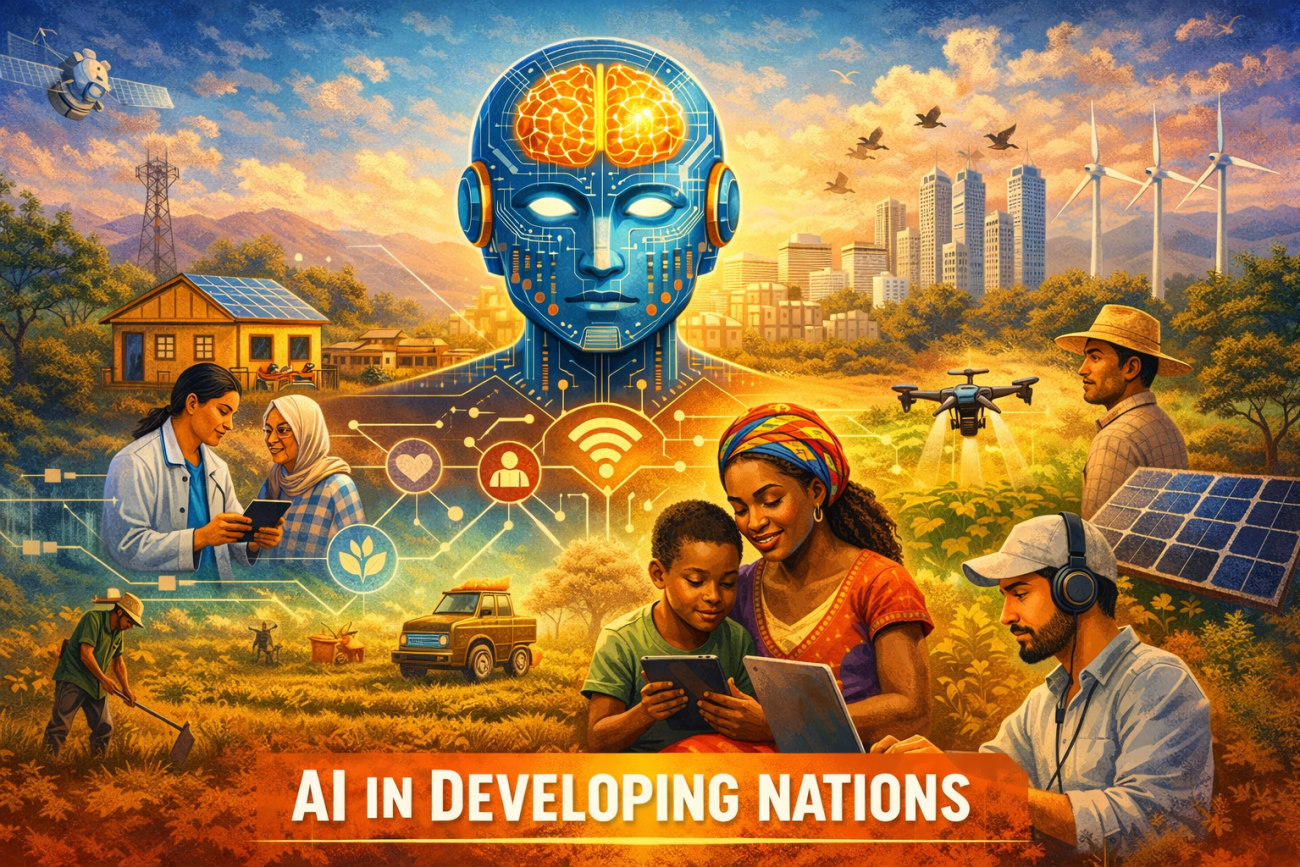
Mauritius is in a very different position from many developing countries: we have stable internet, strong connectivity, and a government that has explicitly made AI a national priority in the 2025–2026 budget. That means the question here is not “Can we access AI?” but “Who in Mauritius is actually able to turn AI into an entrepreneurial advantage, and who risks being left behind?”
Mauritius: good infrastructure, uneven readiness
The 2025–2026 budget positions AI as a catalyst for economic growth under the “Innovative Mauritius” theme, with integration planned across education, agriculture, financial services, and public administration. The ICT sector already contributes significantly to GDP and employment, and the country wants to become an “Intelligent Island” and regional tech hub. This creates a fertile environment for AI‑enabled entrepreneurship: founders can build from Mauritius while serving regional and global markets.
However, good infrastructure at the country level does not mean every entrepreneur is equally ready to benefit. Despite connectivity, many SMEs still lag in basic digital transformation—things like cloud-based systems, CRMs, or integrated online sales—which are often prerequisites for using AI effectively. The gap is less about access to tools and more about skills, mindset, and the capacity to redesign business processes around automation and data.
Where AI can transform Mauritian entrepreneurship
Given current policy and investment signals, several domains are particularly promising for local founders.
Services and BPO 2.0
Mauritius already has a strong outsourcing and services base; layering AI onto this can create “augmented” contact centers, back‑office automation, and specialized AI‑enabled service niches for Africa, Europe, and the Indian Ocean region.
Tourism, hospitality, and the blue economy
AI‑driven personalization, dynamic pricing, and predictive analytics can help hotels, tour operators, and experience providers improve occupancy, upsell, and create more targeted offerings, while digital tools are also being highlighted for diversifying small island economies beyond traditional tourism.
SMEs and local services
Schemes like the SME Technology and Innovation Scheme (TINS) from SME Mauritius Ltd, HRDC training support, and “Enterprise Go Digital” from the National Productivity and Competitiveness Council (NPCC) and partners are actively subsidizing digital adoption for SMEs. Founders who can package AI into simple, outcome‑driven solutions (better leads, faster invoicing, smarter inventory) are well‑placed to build B2B products and services for the domestic market.
Public‑private innovation
The budget includes AI innovation programmes, regulatory sandboxes, and a dedicated AI unit to coordinate national efforts, opening space for startups to co-create solutions with ministries in areas like healthcare, transport, and education. For entrepreneurs, this is an opportunity to build with institutional partners rather than purely on their own.
How the benefits may still be uneven
Even in a relatively connected, policy‑driven environment like Mauritius, AI’s benefits can concentrate among a subset of actors.
Digital maturity divide
Companies already comfortable with cloud tools, data, and automation will integrate AI faster and more effectively than businesses still operating mostly on paper or basic spreadsheets. Over time, these “digitally fluent” firms will pull ahead in productivity and market reach.
Skills and talent concentration
AI literacy, data skills, and advanced technical know‑how are still concentrated in a relatively small pool of professionals, many clustered in ICT and financial services. Without deliberate capacity building for other sectors and regions, AI‑driven growth may remain skewed toward a few industries and urban centers.
Access to support schemes
While programmes like TINS, HRDC training support, and tech sandboxes exist, not all entrepreneurs know how to access them or have the bandwidth to navigate applications. Those with better networks and advisory support are more likely to capture these incentives and turn them into real competitive edges.
Market exposure and networks
Entrepreneurs already plugged into regional or global networks can use AI to scale faster beyond Mauritius, while more locally focused businesses may only scratch the surface of what AI can do. This can widen the gap between “globally oriented” and purely domestic players.
What Mauritius is doing right – and where we must go further:
To its credit, Mauritius has moved beyond rhetoric and into concrete measures: AI integration in public services, an AI Innovation Start‑Up Programme, regulatory sandboxes, tax deductions for AI investments, and a broader digital transformation roadmap for 2025–2029. International partners like UNDP have also supported SME digitalisation projects, emphasizing that digital tools and AI can boost productivity and resilience.
The next step is to ensure these initiatives translate into broad‑based entrepreneurial benefits, not just showcase projects. That means:
- Expanding AI and digital skills programmes specifically targeted at SME owners, not only employees in large firms.
- Simplifying access to funding and support schemes, with more hands‑on guidance for smaller, non‑tech businesses.
- Encouraging local language and context‑aware AI solutions that reflect Mauritian realities rather than just importing generic tools.
- Connecting Mauritian startups to regional small island and African ecosystems to co-build solutions relevant to tourism, the blue economy, logistics, and public services.
- A call to action for Mauritian founders
For entrepreneurs in Mauritius, the opportunity is clear: we operate on a small but well‑connected island that is actively betting on AI and digital as growth engines. The real competitive edge will come from founders who can translate this enabling environment into concrete solutions for real local and regional problems—from SMEs that still need to digitize to tourism operators seeking smarter demand to public services that must become more efficient and citizen‑centric.
The next entrepreneurial boom in Mauritius will not be evenly shared by default. It will favor those who embrace digital transformation, leverage available schemes, and learn how to integrate AI into their business models before it becomes a basic requirement to compete.
From where I sit in Mauritius, I see both sides already: companies quietly using AI to reinvent their operations and others still unsure where to begin despite having the same internet connection and access to tools. The choices we make now—as founders, policymakers, ecosystem builders, and educators—will decide whether AI becomes another layer of inequality or the engine of a more inclusive, innovation‑driven Mauritian economy.
What about you: in your corner of Mauritius, is AI already changing how businesses operate, or is it still mostly a buzzword people talk about more than they use?
Sources & further reading
- EDB Mauritius – Budget 2025–2026: Artificial Intelligence
- Mauritius Budget 2025–2026: AI and Digital Tech
- UNCTAD – Artificial intelligence unleashed: Transforming the entrepreneurial scene in developing nations
- CGD – Three Reasons Why AI May Widen Global Inequality
- UNDP – Digitalisation of Small and Medium Enterprises in Mauritius
- UNDP – Small Island Digital States: How digital can catalyse SIDS development

About the Author
Faaleh M. Sookye is an AI consultant and AI strategy specialist helping Mauritius SMEs and enterprises with AI readiness assessments, governance frameworks, and digital transformation. As a doctoral researcher in AI adoption for Mauritian businesses and lead in digital transformation at SME Mauritius, he addresses the typical 42% SME AI readiness gap using his proprietary ProjectSpine™ methodology; prioritizing execution discipline before technological acceleration. With 15+ years advising entrepreneurs across Mauritius, Africa, Singapore, and internationally, Faaleh delivers practical AI implementation through custom strategy roadmaps, organizational execution, PDPA compliance, HRDC training alignment, and grant optimisation.